
Most drivers only think about their tyres when something goes wrong. A sudden flat on Sheikh Zayed Road. A blowout at speed. A failed RTA inspection. By then, a visit to a tyre shop in Dubai becomes urgent rather than planned. But the truth is, worn tyres almost always show warning signs long before they cause serious trouble.
Knowing what to look for can save you from an accident, a fine, and an expensive repair bill. Read on to understand the key signs your car tyres need replacement, what each sign means, and what to do about it.
Why Tyre Condition Matters More in Dubai
Dubai's road conditions are harder on tyres than most people realise. Road surface temperatures regularly exceed 60°C in summer. High-speed highways, sandy roads, and frequent emergency braking all add up. The UAE's extremely hot temperatures cause tyres to lose elasticity and become more prone to early damage.
In the UAE, car tyres cannot be older than 4 years. Cars with tyres older than four years will not pass the RTA's yearly inspection required to renew vehicle registration, and the reason is the extreme heat that accelerates tyre ageing faster than in most other countries.
This makes regular tyre checks not just a safety habit, but a legal requirement. Knowing when to change tyres in the UAE can save you from fines, failed inspections, and road accidents.
1. Tread Depth Is Too Low
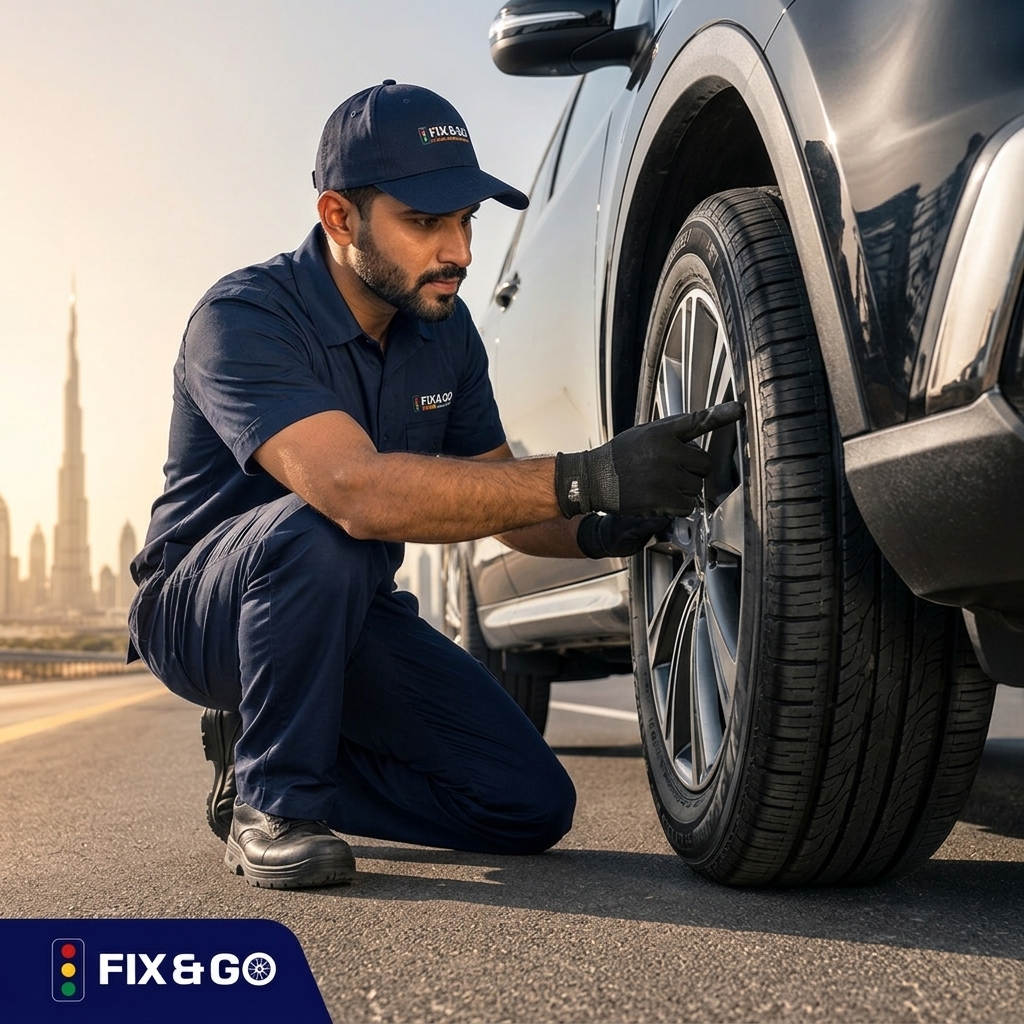
Tread is the pattern on your tyre that grips the road. As it wears down, your car takes longer to stop, loses grip on wet roads, and becomes harder to control.
The legal minimum tread depth in the UAE is 1.6mm, as required by the RTA. If tread depth falls below this, it is time to replace the tyre.
A quick way to check: press a coin into the tread groove. If you can see the top of the coin clearly, your tread is dangerously low.
What to do: Get the tyres inspected immediately. Do not wait for the next service. Driving with worn tread is a traffic violation in the UAE.
2. Cracks or Cuts on the Sidewall
The sidewall is the side surface of the tyre. It protects the internal structure and keeps air in. When it starts cracking, the tyre is no longer structurally safe.
Sidewall cracks are caused by heat, UV exposure, age, and under-inflation. In Dubai's climate, this process speeds up significantly. Look out for:
- Fine surface cracks that run across the sidewall
- Deep cuts or tears from kerb impact or road debris
- Any visible damage that goes below the surface
What to do: Do not drive on a tyre with sidewall damage. A cracked sidewall can fail without warning. Replace it immediately.
3. Bulges or Blisters on the Tyre Surface
A bulge on the tyre means the internal structure has broken down in that spot. Air pressure is pushing outward through the damaged area, creating a visible bump.
A bulge or blister on the tyre surface is usually a sign of internal damage. This is when the tyre's inner structure weakens, and air pressure forces the rubber outwards, increasing the risk of sudden tyre failure while the vehicle is in motion.
What to do: Stop driving on that tyre. A bulge does not get better with time. It is a blowout waiting to happen, especially at highway speeds.
Unsure About Your Tyres? Don't Guess.
Fix and Go's certified technicians come to you, check your tread depth, sidewall condition, tyre age, and pressure, and give you an honest assessment before recommending anything.
WhatsApp Us for a Free Inspection4. Frequent Loss of Tyre Pressure
If you are topping up the air in the same tyre every week, something is wrong. A healthy tyre holds its pressure for weeks at a time.
Frequent pressure loss can be caused by:
- A slow puncture from a nail or sharp object
- Damage to the valve stem
- A crack or break in the sidewall
- Age-related rubber degradation
What to do: Have the tyre professionally inspected. A slow leak left unattended is one of the most common causes of a flat tyre in Dubai. If the puncture is in the tread area and within repair limits, it can often be patched. If the damage is on the sidewall or too large, it needs to be replaced. Our tyre fitting and repair service can assess this on-site, wherever you are in Dubai.
5. Vibration or Unusual Noise While Driving
Some vibration is normal on rough roads. But if you feel persistent shaking in the steering wheel or throughout the car on smooth roads, your tyres may be the cause.
Unusual vibrations while driving can be a sign of tyre wear or an issue with wheel alignment. Unusual noises, such as thumping or excessive road noise, can also indicate that tyres need replacement due to irregular wear.
What to do: Start with a wheel balancing check. If vibrations continue after balancing, the tyres themselves may be unevenly worn and need replacing.
6. Uneven Wear Across the Tyre
Healthy tyres wear evenly across the whole tread surface. If you notice that one side is more worn than the other, or there are patches of heavy wear, something is off.
Common causes include:
- Wheel misalignment
- Incorrect tyre pressure over time
- Suspension issues
- Driving habits like hard cornering or sudden braking
What to do: Get your wheel alignment checked right away. Address the root cause before fitting new tyres, otherwise the new set will wear unevenly too.
7. Your Tyres Are Too Old
Tyres can look fine on the outside while the rubber compound inside has broken down. Age alone is a valid reason to replace them, even if tread depth looks acceptable.
The UAE's RTA requires passenger vehicle tyres to be changed every 5 years from the date of manufacture, even if unused. However, given Dubai's heat, many tyre professionals recommend replacing them every 4 years.
You can find the manufacturing date on the tyre sidewall. Look for a 4-digit number: the first two digits are the week, the last two are the year. For example, 1823 means the 18th week of 2023.
What to do: Check the manufacturing date on all four tyres today. If any are approaching or past the 4-year mark, book a replacement before your next RTA inspection.
What Happens If You Ignore These Signs?
Under UAE tyre regulations, ignoring worn tyres does not just put you at risk on the road. It also puts you on the wrong side of the law.
- Tyres with a tread depth below 1.6 mm are a traffic violation
- Tyres older than the RTA-permitted age will fail your vehicle inspection
- A blowout at speed can result in loss of control and a serious accident
- Driving on damaged tyres may void your vehicle insurance in the event of a claim
The cost of replacing tyres on time is always less than the cost of what can happen when you do not.
How to Check Your Tyres at Home
You do not need a workshop to do a basic tyre check. Here is what to look for:
- Tread depth: Use a coin or tread depth gauge. If the tread is near or below 1.6mm, replace it immediately.
- Visual check: Walk around the car and look at each tyre. Check for cracks, bulges, cuts, and embedded objects.
- Pressure: Use a tyre pressure gauge or check at a petrol station. Refer to your car door sticker for the correct figure.
- Sidewall date code: Find the 4-digit DOT number and confirm the manufacturing year.
- Vibration check: On your next drive, pay attention to unusual shaking or noise.
Do this once a month and before any long journey. It takes less than five minutes, and it can prevent serious problems.
When Repair Is Enough and When It Is Not
Not every tyre problem means a full replacement. A puncture in the central tread area, if it is small enough and in the right location, can often be safely repaired.
Replacement is necessary when:
- The damage is on the sidewall
- The puncture is too large to patch
- The tyre has a bulge or blister
- Tread depth is at or below 1.6mm
- The tyre is over 4 to 5 years old
If you are unsure, a professional inspection is the safest call. Our team at Fix and Go will always tell you honestly whether a repair is possible before recommending a replacement.
Fix and Go: Tyre Replacement That Comes to You
At Fix and Go, Dubai's trusted mobile tyre service with a 4.9 Google rating and thousands of successful tyre replacements completed across the city, we make tyre replacement as simple as possible for every driver.
We carry Michelin, Bridgestone, Pirelli, Goodyear, Dunlop, Continental, Yokohama, and Hankook tyres for all vehicle types, including sedans, SUVs, luxury cars, and EVs.
Book Your Tyre Check or Replacement Today
Get back on the road safely. Fix and Go comes to you anywhere in Dubai for tyre inspection and replacement.